
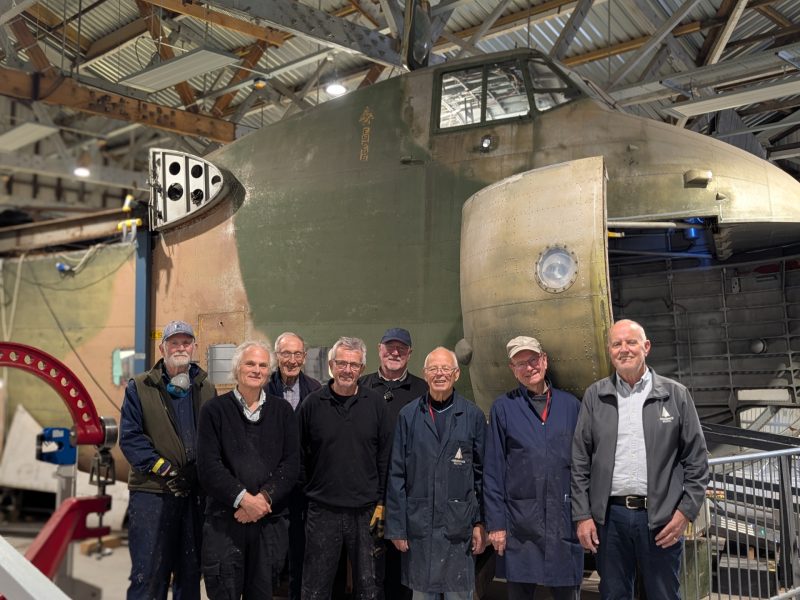
Some of the volunteers, who are experienced aerospace engineers, contributing to the freighter’s conservation
Aerospace Bristol has begun its boldest project yet — conserving the only Bristol Freighter aircraft left on the continent.
The museum officially launched the project on May 21, with work already underway to carefully conserve and reassemble its Bristol Freighter T170.
The programme will run over several years and will be open for the public to watch as it happens — both at the museum and online.
The freighter was designed and built in Bristol in the late 1940s and early 1950s by the Bristol Aeroplane Company.
Recognisable by its distinctive clamshell nose doors and 108- foot wingspan, it could carry everything from vehicles to livestock, and was later adapted for passenger travel.
It was the first post-war aircraft to receive an unrestricted Certificate of Airworthiness. Of just 12 surviving examples worldwide, Aerospace Bristol’s aircraft — serial number NZ5911 — is the only one still in Europe. It served with the Royal New Zealand Air Force from 1955, flying missions across Southeast Asia during the Cold War and the Vietnam War era.
It was brought back to Bristol in 2018 after volunteers led a major international recovery effort to retrieve it from storage in New Zealand.
The aircraft will be moved out of its current hangar and reassembled outdoors, as once the wings are reattached, it will be too large to fit inside. Final conservation work will include corrosion removal and weatherproofing.
Kate Rambridge, interpretation lead at Aerospace Bristol, said: “This is a once- in-a-generation opportunity to conserve and share the story of an extraordinary aircraft. The Bristol Freighter connects Bristol’s world-leading aviation heritage with global histories of innovation, conflict and travel.”
Sally Cordwell chief executive at Aerospace Bristol, said: “This project represents everything Aerospace Bristol stands for. It’s about preserving our history, celebrating the contribution and stories of the people behind Bristol’s aviation legacy and inspiring future generations”.
Up to 50 skilled volunteers, many of them former aerospace engineers and ex-Bristol Aeroplane Company employees, are expected to contribute more than 10,000 hours to the project between them.