
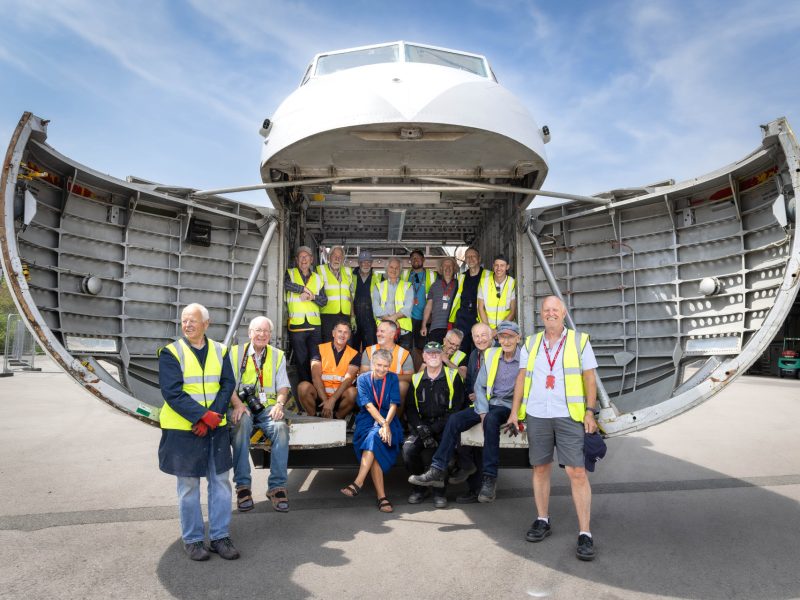
CEO Sally Cordwell with the volunteer team in front of the Bristol Freighter. Image: First Avenue Photography
Following years of careful conservation efforts, Europe’s only surviving Bristol Freighter T170 is back on its feet.
Aerospace Bristol’s biggest-ever conservation project has successfully raised the 70-year- old aircraft to fit its main landing gear, enabling it to stand tall once again.
The complex piece of engineering, carried out by the museum’s specialist conservation team, was made possible by the expertise of the volunteers and former aerospace engineers who have contributed thousands of hours to the project.
The milestone is one step closer towards the freighter being a structurally complete, freestanding aircraft and the centrepiece of Aerospace Bristol’s new outdoor exhibition.
Sally Cordwell, CEO of Aerospace Bristol, said: “Seeing our freighter standing tall is a truly special moment for everyone who has contributed to this project. It is a testament to the skill, dedication and sheer number of hours of work that our team has put into bringing this beautiful aircraft back to life.
“There’s more to do, but seeing this project becoming a display that truly allows visitors to experience a remarkable piece of Bristol’s aviation heritage up close is incredibly rewarding for us.”
The Bristol Freighter was designed and built in Filton by the Bristol Aeroplane Company and is one of just 12 surviving examples anywhere in the world and the only one in Europe. It served with the Royal New Zealand Air Force before making the long journey back to its birthplace in 2018.
Since then, the aircraft has undergone years of painstaking and complex conservation work at Aerospace Bristol.
In July, it was moved outside from its conservation hangar for the first time since returning to Bristol, where it will remain as conservation work continues.
The project is being delivered by a dedicated team of up to 50 specialist volunteers, former aerospace engineers and ex- Bristol Aeroplane Company employees, including a 90-year- old ex-apprentice, who are expected to contribute a total of 10,000 hours to preserving the aircraft for future generations.
The Freighter’s distinctive 108ft wings are being conserved separately and will be reattached as the project progresses.