
By Shane Gibson
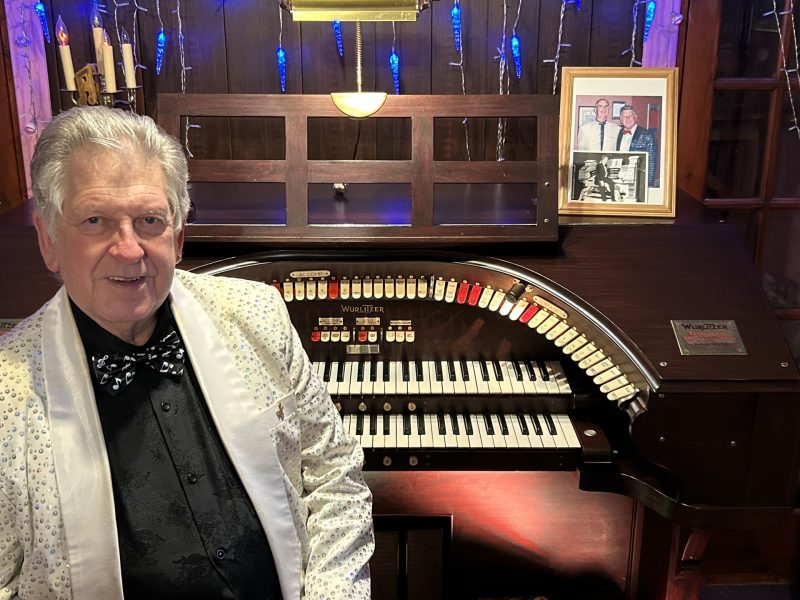
Local celebrity the Welsh Wizard Byron Jones BEM celebrates his 60th career anniversary this year and coincidentally his organ’s 100th birthday.
Byron began working as an organist at the age of 17, in a working men’s club.
“I was working three nights a week for £9 which all those years ago was a lot of money,” Byron recalls.
He began playing in between bingo games and as his career progressed, he would add more to his repertoire, playing at bigger clubs for larger audiences whilst improving his craft and learning how to play for dancers, cabaret acts, and comedians.
Byron would eventually find himself playing at a Cardiff nightclub with such esteemed singers as Donald Peers and Ruby Murray, before leaving for America.
He said: “I had developed into playing for concerts and so… I went to America; I have played 12 tours across America over the years. I played in the big theatres that held 2,000 to 3,000 people.”
Crafting his own style of performance, Byron stood out from the other organists.
“I’m a people’s person. Before the show, I’ll have a little chat with them and then maybe ask them what type of music they like and what songs would they like to hear.
“If I know it, I’ll put it in. Some of the old girls would have their own seats and would come back each year and I would say, ‘oh no not you again’ and they loved it.
“The American organists would just play one piece of music, explain who composed it and then bore the pants off
the audience.”
One of the organs that Byron played over the decades was the DX style Wurlitzer Opus 1230.
It was one of around 57 deluxe models with twin- chamber pipe work.
The Opus was shipped from the Tonawanda factory on December 31, 1925 to Gowanda, New York State, 48 miles away.
It would be installed in the Hollywood Theatre on West Main Street. This was a new 990-seat state-of-the-art movie theatre, which would become a cultural hub hosting not only silent films but also live performances, community events, and concerts with the Opus as the beating heart at the centre.
The rise of talkies and films with synchronised sound in the late 1920s brought new challenges and opportunities. The Opus, originally designed for silent film accompaniment, adapted to new roles, including intermission entertainment and special event performances.
Despite periods of decline and disrepair, the organ remained intact. Restoration efforts in the late 20th and early 21st centuries brought renewed attention to its historical value. Volunteers and preservationists worked tirelessly to restore both the theatre and the organ to their former glory.
Today, the organ stands fully working in Byron’s home.
After many concerts including at the Bristol Beacon, formerly Colston Hall, and at the age of 77, Byron continues to put on concerts for attentive fans and new audiences alike.
“Naturally, I don’t do so much because of the driving, and I lost my partner around nine years ago. I still go out and ask everyone if they are having a good time, and then I come home alone. But the show goes on.
“He was the organiser and I am the organist. Now I must deal with the office work and deal with the computers, I hate the things,” laughed Byron.
Looking back over his career, Byron said that the highlight was being invited to play at Blackpool Tower.
“I played a number of concerts there and then I played one or two dances that upset the older audience members – they said that I was playing it too fast! So, I told ’em next year we can have a geriatrics jive.
“You should have seen their faces; they looked as if the devil himself had just appeared.”
Of course, not all of Byron’s audiences took things so seriously.
“I was at St David’s Hall in Cardiff for a big celebrity concert. I played a bit of a sing-along at the end, when someone dared me to play the Birdie Song. I
said you dare me, do you? So, I played the song and a quarter
of the audience stood up and did the dance. The conductor was spitting feathers. Then I played Dambusters, and you can imagine what happened next!”
Byron’s entertaining performances have allowed him to stay popular with audiences. And it is Byron’s efforts to connect with people after the show that keep them coming back.
“Some of the people that come to my shows aren’t well. But afterwards I go and speak to them, and they tell me how much better they are feeling.
“You know I don’t play ‘BANG, BANG, BANG’ it’s gentle stuff, its opera, a little bit of jazz, sing-along stuff, I give the people what they want. As we say, you play to the balcony lot.”
Byron was awarded the British Empire Medal (BEM) in 2018 for his contributions to community life and his dedication to music and charity. He still performs regular concerts with one scheduled for August and you can see him weekly on his live streams on YouTube at tinyurl.com/byron-jones-youtube